Outcome Based Education Means for Business Growth

Introduction
In today’s competitive economy, companies no longer hire based solely on degrees. Instead, they prioritize measurable skills, professional competencies, and real-world performance. Consequently, there is growing interest in understanding what outcome-based education means and how it supports workforce readiness.
This approach is not just an academic model. Rather, it directly impacts business growth, talent development, and organizational performance. Companies benefit when education systems produce graduates who can demonstrate clear, measurable learning outcomes.
In this guide, you will discover how OBE connects education with business success and workforce development.
Meaning in a Business Context
Outcome based education means an approach to learning that focuses on clearly defined and measurable outcomes rather than just course content. This method ensures that students graduate with job-ready skills that align with industry expectations.
Moreover, OBE’s meaning in education refers to designing curriculum, instruction, and assessment around measurable student outcomes. From a business perspective, it emphasizes results over theory, helping reduce onboarding costs and improving productivity.
Key aspects of outcomes-based education definition include:
-
Clear and measurable learning outcomes
-
Student-centred learning
-
Continuous assessment and improvement
By focusing on measurable achievement, OBE allows organizations to hire graduates ready to contribute immediately.
Why Outcome-Based Education Matters for Businesses
Traditional education models often focus on memorization rather than applied competence. As a result, many companies find that graduates are unprepared for practical challenges.
Understanding what outcome based education means helps business leaders recognize its value in several areas:
-
Strengthening the talent pipeline
-
Aligning curriculum design with industry needs
-
Improving student achievement in job-related competencies
-
Enhancing accountability and measurable performance
Additionally, businesses benefit when universities and training institutes concentrate on outcomes that reflect workforce requirements. This approach ensures graduates possess both the knowledge and skills necessary for immediate contribution.
Core Principles of OBE That Support Business Needs
Several principles make outcome-based education especially valuable to organizations:
1. Clarity of Learning Outcomes
Every program defines specific skills and knowledge that students must demonstrate.
2. Industry Alignment
Curriculum is developed with input from industry to ensure market relevance.
3. Performance-Based Assessment
Assessment methods evaluate actual capabilities instead of rote memorization.
4. Continuous Improvement
Programs are updated regularly based on feedback and performance results.
By integrating these principles, outcome based education creates graduates who are ready to meet professional expectations.
Key Features of Outcome-Based Education
Outcome-based education includes several key elements that appeal to business stakeholders:
-
Focus on professional competencies
-
Measurable learning outcomes
-
Real-world application through projects and case studies
-
Structured assessment methods
-
Student-centred learning and accountability
Furthermore, assessment methods in OBE, such as simulations, performance tasks, and rubrics, mirror workplace demands. This ensures graduates are prepared for real challenges and responsibilities.
How Outcome-Based Education Works in Talent Development
Understanding how outcome-based education works can clarify its impact on workforce readiness:
Step 1: Define Industry-Relevant Outcomes
Institutions collaborate with businesses to identify essential competencies.
Step 2: Align Curriculum with Market Demands
Curriculum design integrates practical projects and applied learning experiences.
Step 3: Implement Structured Assessment
Performance tasks, case studies, and rubrics measure skill application effectively.
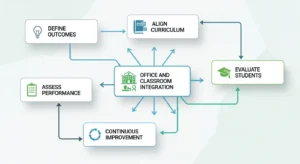
Step 4: Evaluate Student Performance
Data from assessments ensures outcomes are consistently achieved.
Step 5: Improve Based on Feedback
Continuous feedback allows programs to remain aligned with evolving business needs.
By following these steps, organizations can secure a steady flow of capable professionals.
Types of Outcomes in OBE
Learning outcomes in OBE can be grouped into different categories relevant to business:
-
Knowledge Outcomes: What students know after instruction
-
Skill Outcomes: What students can perform or demonstrate
-
Attitude Outcomes: Changes in values or professional behavior
-
Competency Outcomes: Integrated abilities combining knowledge, skills, and attitudes
Providing clear examples of learning outcomes helps align education with the practical requirements of businesses.
Benefits
OBE provides several advantages from an industry perspective:
Reduced Training Costs
Graduates arrive with measurable skills, lowering onboarding time.
Improved Productivity
Employees demonstrate competencies from the start.
Stronger Talent Alignment
Learning outcomes reflect actual job requirements.
Enhanced Innovation
Students trained through outcome-based learning develop critical thinking and problem-solving abilities.
In other words, outcome based education means creating a workforce capable of delivering results immediately, which benefits organizational efficiency.
Challenges Businesses Should Consider
Despite its benefits, the challenges of implementing OBE can impact both institutions and organizations:
-
Poorly defined learning outcomes may reduce effectiveness
-
Lack of faculty or trainer preparation can hinder implementation
-
Weak curriculum alignment can limit value
-
Insufficient collaboration between academia and industry
However, businesses can mitigate these challenges by partnering with institutions and actively participating in program development.
Outcome Based vs Traditional Education from a Business Viewpoint
Traditional education emphasizes theoretical knowledge and exam performance. On the other hand, OBE measures performance, skill application, and competency development.
Key differences include:
-
The traditional model evaluates memory recall, while OBE evaluates skill execution
-
Traditional teaching is content-driven; OBE is outcome-focused
-
Businesses benefit more from OBE because graduates are job-ready
This comparison demonstrates why many organizations prefer graduates trained under outcomes-based education models.
Outcome Based vs Competency Based Education
Outcome based vs competency based education is often discussed in corporate training:
-
Outcome-based education focuses on achieving program-level learning outcomes
-
Competency-based education focuses on mastering individual competencies at the learner’s pace
Both emphasize measurable performance, but OBE ensures structured curriculum alignment for an entire program, making it suitable for businesses needing standardized workforce readiness.
Real World Business Examples of OBE
Examples of outcome-based education applied to workforce development include:
-
Engineering programs aligned with industry certifications
-
Business schools using real company case studies
-
Vocational training programs with workplace simulations
These examples illustrate clearly what outcome-based education means in practice, helping businesses acquire graduates who meet professional standards from day one.

Common Misunderstandings About OBE in Business
Some misconceptions include:
-
OBE reduces academic depth
-
It only focuses on technical skills
-
Exams are completely eliminated
In reality, outcome based education means strengthening standards through measurable objectives, structured assessment, and integrating knowledge, skills, and professional behavior.
This approach produces well-rounded graduates ready to perform in a business environment.
FAQs
How does OBE help businesses?
It ensures graduates have measurable skills that match market requirements.
Does OBE improve employee performance?
Yes. Structured assessment and measurable outcomes guarantee competency before workforce entry.
Is OBE suitable for corporate training?
Absolutely. Many organizations adopt outcome-based frameworks to enhance internal talent development.
Conclusion
Understanding what outcome based education means allows business leaders to appreciate its role in workforce readiness and organizational success. By emphasizing measurable learning outcomes, structured assessment, and curriculum alignment with industry needs, OBE strengthens the connection between education and business growth.
Ultimately, companies benefit when education systems produce graduates capable of delivering real results, enhancing productivity, and supporting competitive advantage.









Post Comment