Compound Interest Explained: How Your Money Can Grow Over Time
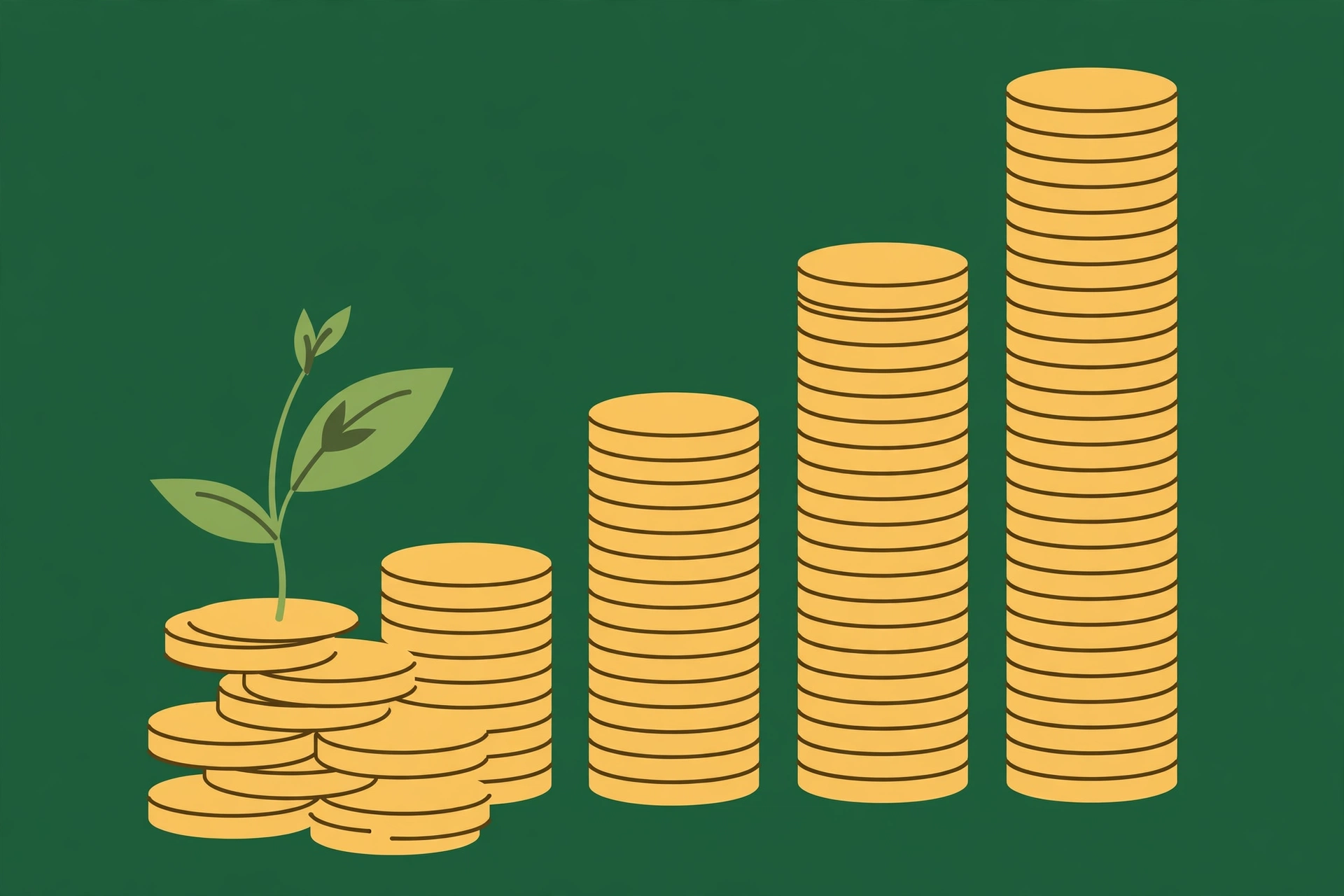
If you have ever wondered why two people can save the same amount and end up with quite different balances, compound interest is usually a large part of the answer. It is not a trick, and it is not a special product. It is simply what happens when the interest you earn starts earning interest of its own.
This guide explains compound interest in plain terms: what it is, how it differs from simple interest, the formula without the jargon, a worked example you can follow, and the mistakes that catch people out. It is general education only, not financial advice. Nothing here recommends a particular account, fund, or investment, and no return is promised. Actual rates vary, and they can fall as well as rise.
What is compound interest?
Compound interest is interest paid on your original amount plus any interest that has already built up. Each time interest is added, the balance it is calculated on grows a little. Over time, that small change repeats, and the growth starts to pick up speed.
Simple interest, by contrast, is calculated only on the original amount, every time. At a fixed simple rate you earn the same amount each year, because the amount it is worked out on never changes. That is easier to predict, but it misses the extra growth compounding can bring.
For example, £1,000 at an illustrative 5% a year would reach £1,500 after ten years with simple interest, but about £1,629 with annual compounding at the same rate. The gap widens the longer the money stays put.
The compound interest formula, in plain terms
You may have seen the formula written as A = P(1 + r/n)^(nt). It looks forbidding, but each letter stands for something ordinary:
- P is the principal, the amount you start with.
- r is the annual interest rate, written as a decimal, so 5% becomes 0.05.
- n is how often interest is added each year. If it is added once a year, n is 1. If it is added monthly, n is 12.
- t is the number of years.
- A is the final amount, including both your original money and the interest.
So the formula is really saying: take your starting amount, add the rate for each compounding period, and repeat that for every period. A calculator for compounding interest does exactly this arithmetic for you, which is why “calculator for compounding interest” and “estimate compound interest” are such common searches. You do not need to work it out by hand, but it helps to know what the calculator is doing, so you can spot a wrong input. The most common error is entering a monthly rate where an annual rate is expected, or forgetting whether the figure you have been quoted is before or after tax and charges.
How often interest is added matters, but usually less than the rate and the length of time. Monthly compounding edges ahead of annual compounding at the same rate, because each month’s interest starts earning sooner, but the difference is small compared with saving for twenty years instead of five.
A worked example
Take one example, using clearly illustrative figures only. These are not rates you can expect to get, and they are not a recommendation. Start with £10,000, at an illustrative 5% a year, compounded once a year, with no withdrawals and no extra deposits:
| End of year | Balance |
|---|---|
| Year 1 | £10,500.00 |
| Year 2 | £11,025.00 |
| Year 3 | £11,576.25 |
| Year 5 | £12,762.82 |
| Year 10 | £16,288.95 |
In year one the interest is £500 (5% of £10,000); in year two it is £525 (5% of £10,500). By year ten it is over £775, because it is calculated on a balance above £15,500. The rate never changed; the balance did, and that is the whole point. You can verify the year-ten figure yourself: £10,000 × 1.05^10 = £16,288.95. By comparison, simple interest at 5% would reach £15,000 after ten years, so compounding adds about £1,289 here. Over twenty years the gap grows far larger.
The same arithmetic scales up: at an illustrative 5% for one year, £1,000,000 would earn £50,000 before tax, fees, or charges. That is illustration only: nobody can promise 5%, and your actual rate depends on the account and on market conditions.
What affects how fast compound interest grows
Four things matter most, and they are worth weighing in this order.
Time. This is the factor people underestimate most. Starting earlier usually beats starting with a larger amount later, because compounding needs years to do its quiet work. A modest sum left alone for decades can outgrow a larger sum started late, though no outcome is guaranteed.
Rate. A higher rate grows money faster, but usually comes with higher risk, less flexibility, or both. An unusually generous rate deserves a careful look at what you would be giving up to get it.
Regular contributions. Adding money regularly can matter most of all, because each new deposit gets its own chance to compound.
UK details: AER and tax
UK savings accounts are usually compared by AER, the Annual Equivalent Rate: what you would earn over a year once compounding is taken into account. AERs let you compare accounts fairly even when interest is added at different frequencies. Tax is separate. For 2026/27 the Personal Savings Allowance is £1,000 a year for basic-rate taxpayers and £500 for higher-rate taxpayers, with none for additional-rate taxpayers; interest above it is taxed at your usual rate. Tax rules change, so check GOV.UK before relying on any figure.
Two things that reduce growth are easy to overlook: charges, which eat into the balance that would otherwise compound, and inflation. Your balance may rise while its purchasing power rises more slowly, or even falls, if prices rise faster. That is why comparing a return with inflation matters, even though inflation is not part of the formula itself.
Thinking like a calculator, without buying anything
A free online calculator for compounding interest can help you compare scenarios, but check four inputs first: the starting amount, the rate and whether it is annual, how often interest is added, and the time period. Most simple calculators leave out tax, charges, and inflation, and none can predict future rates.
It also helps to run the same figures at a lower rate than you hope for. If a plan only works at an optimistic rate, it is fragile; if it still looks sensible at a cautious rate, it is on firmer ground.
When interest appears on your own statements, read the entries rather than assuming them. If a line puzzles you, our guide to what a PNP bill payment entry means on a bank statement shows how to approach an unfamiliar entry, though details differ by bank: check what was added, when, and on what balance.
For background on how interest rates themselves are set in the UK, the Bank of England’s explainer on what interest rates are is a useful, authoritative read.
Common mistakes
Expecting steady growth. Compound interest is often drawn as a smooth upward curve. Real balances rarely behave that neatly: rates change, markets move, and some years will be flat or negative. The curve is an illustration, not a promise.
Forgetting the other side. Compounding works on debts too, and there it works against you. Interest added to a loan balance increases the amount future interest is charged on, which is why carrying a balance can become expensive faster than people expect.
Chasing the highest rate without reading the terms. A higher rate may come with a lock-in, a penalty for early withdrawal, or a variable rate that can fall. The headline figure is only part of the picture.
Trying to catch up with risk. If time has been lost, the temptation is to take bigger risks to make up for it. That can backfire. Regular, affordable saving, started as soon as it is practical, is usually the steadier path, though independent financial advice can help with a decision that fits your situation.
A final word
Compound interest rewards patience more than cleverness. Check the inputs behind any estimate, keep charges and inflation in mind, and do not let a smooth chart persuade you that a return is guaranteed. At its simplest, it is interest on your money, and then interest on that interest, repeated over time.
General-education note: This article is general information only and is not financial advice. It does not recommend any account, fund, or investment. Rates, tax rules, and charges vary and change over time. For decisions about your own money, consider speaking to an independent financial adviser.
FAQs
What is compound interest in simple words?
Compound interest is interest earned on your original amount plus interest you have already earned. Because the balance grows, later interest is calculated on a larger amount, so growth tends to speed up over time.
How is compound interest different from simple interest?
Simple interest is calculated only on the original amount, so you earn the same amount each year at a fixed rate. Compound interest is calculated on the original amount plus accumulated interest, so the amount earned each year can rise as the balance grows.
How do I estimate compound interest?
Use the formula A = P(1 + r/n)^(nt), or a reputable compounding calculator, and check the starting amount, the annual rate, how often interest is added, and the time period. Remember that most estimates leave out tax, charges, and inflation, and that future rates are not guaranteed.
How much interest will I earn on £1,000,000?
That depends entirely on the rate, the period, and any tax or charges. As pure illustration, £1,000,000 at 5% for one year would earn £50,000 before deductions. That is arithmetic, not a rate you should expect or a return anyone can promise.
Does compound interest work on debts too?
Yes, and in the opposite direction. When interest is added to a loan balance, future interest is charged on the larger balance, which is why unpaid debts can grow faster than people expect. The same principle that helps savers can work against borrowers.
Is compound interest guaranteed?
No. Rates vary, can fall, and investment values can go down as well as up. The examples in this article use illustrative rates to show how the maths works, not to promise any outcome.









Post Comment